Shadow Fight 2 Enemy Types Explained and How to Fight Them
Learning how to fight different Shadow Fight 2 enemy types can make difficult battles much easier. Some opponents attack quickly, while others use long-range weapons, powerful strikes, magic, or defensive tactics. Using the same strategy against every enemy can lead to unnecessary damage and repeated losses.
The key is to understand your opponent before committing to an attack. Watch their movement, learn their weapon range, avoid predictable attacks, and look for safe opportunities to counter. Your weapon, armor, and magic also matter, but good timing and distance control are just as important. If you want to explore the game’s main features and available versions, visit our Shadow Fight 2 Home page.
This guide explains the main enemy fighting styles, practical ways to counter them, and strategies for dealing with the game’s major demon bosses.
What Types of Enemies Are in Shadow Fight 2?
Shadow Fight 2 does not need to be treated as having a fixed set of official enemy classes to understand how opponents fight. For practical purposes, you can group enemies by their behavior, weapon range, attack speed, and defensive habits.
These categories help you decide how to approach a fight instead of relying on one attack strategy.
| Enemy fighting style | Main challenge | Recommended approach |
|---|---|---|
| Fast and aggressive | Little time to react | Keep attacks short and watch their movement |
| Defensive | Difficult to land clean hits | Create openings and vary your attacks |
| Long-range weapon user | Can hit you before you get close | Control distance and approach carefully |
| Heavy attacker | Powerful attacks can punish mistakes | Evade, then counter during recovery |
| Unpredictable opponent | Attack timing is difficult to read | Observe first and avoid risky combos |
| Demon boss | Special abilities and challenging attack patterns | Adapt your equipment and strategy to the boss |
An opponent may fit more than one category. A weapon can also affect how an enemy attacks, so pay attention to both their behavior and their equipment.
1. How to Fight Fast and Aggressive Enemies
Fast enemies can make you feel as though you never have enough time to attack. They may close the distance quickly, interrupt your moves, or punish you when you repeatedly use slow attacks.
Why these enemies are difficult
The main problem is committing to an attack before you have a safe opening. If you keep pressing attack buttons without watching your opponent, you may leave yourself open to a counterattack.
Best strategy against fast enemies
- Use shorter attacks: Start with quick, controlled moves rather than long combinations.
- Watch their approach: Notice when they move into range or begin an attack.
- Keep enough distance: Step away when you need time to recover or reassess the situation.
- Counter after a missed attack: If the enemy’s move leaves them exposed, use that opportunity instead of attacking blindly.
- Avoid predictable repetition: Changing your timing can make your own attacks harder to anticipate.
Practical tip: Spend the first few exchanges learning how quickly the opponent attacks. Once you understand their rhythm, choose a safe opening and return to a defensive position instead of continuing to attack without a plan.
2. How to Beat Defensive Enemies
Defensive opponents can block or avoid many attacks, making it tempting to attack more aggressively. However, repeated attacks against a prepared opponent may waste opportunities and expose you to counters.
Why these enemies are difficult
Your attacks may fail to connect cleanly, and an opponent that keeps blocking can frustrate players who depend on the same combination.
Best strategy against defensive enemies
- Change your attack pattern: Mix different attacks instead of repeating the same move.
- Use movement to create opportunities: Adjust your distance and wait for the opponent to respond.
- Look for recovery openings: If an enemy finishes an attack or commits to a move, consider a quick counter.
- Avoid unnecessary heavy attacks: Slower moves can leave you vulnerable if the opponent remains ready to defend.
- Be patient: A safe opening is more valuable than several attacks that accomplish nothing.
Throws may help against opponents who rely heavily on guarding, but their success depends on distance and timing. Do not assume every throw will connect.
Practical tip: If an enemy blocks most of your attacks, stop repeating the same combination. Change your timing, reposition yourself, and attack when the opponent is less prepared.
3. How to Fight Enemies With Long-Range Weapons
Some weapons can reach you from farther away than others. Facing an opponent with a spear, staff, or kusarigama can be difficult if you try to rush straight toward them.
Why these enemies are difficult
You may take damage while approaching, especially if you enter the weapon’s range without considering its attack timing.
Best strategy against long-range enemies
- Study the weapon’s reach: Notice how far away the opponent can hit you.
- Avoid rushing in a straight line: Approach carefully and watch for incoming attacks.
- Move after the opponent commits: An attack that misses may create an opportunity to close the gap.
- Use your own weapon’s reach wisely: A longer weapon can help you maintain distance, while a faster weapon may suit a more mobile approach.
- Do not retreat automatically: Moving backward can help, but constant retreat may leave you with fewer useful attack opportunities.
Once you get close, do not assume you have already won the exchange. Some opponents can still attack quickly at close range.
Practical tip: Learn the difference between standing outside the enemy’s reach and moving just inside it. Rushing in too early can cost health before you even begin your attack.
4. How to Handle Heavy and Powerful Attackers
Heavy attackers can punish careless movement with high-damage strikes. Their attacks may also take longer to execute, giving you an opportunity to react if you recognize the animation early enough.
Why these enemies are difficult
A single poorly timed attack can leave you vulnerable to a powerful response. Trying to trade hits may also be a bad choice when your health is already low.
Best strategy against heavy attackers
- Prioritize avoiding clean hits: Protect your health instead of trying to win every exchange.
- Watch for attack animations: Learn when the opponent begins a heavy move.
- Move out of danger when possible: Use appropriate movement or dodging rather than assuming you can interrupt every attack.
- Counter after the attack finishes: If the opponent has a recovery window, use a quick, controlled attack.
- Choose manageable combinations: Avoid committing to a long combo when the enemy can punish you before it finishes.
Practical tip: Let the enemy reveal their attack first. When you recognize a slow, committed move, focus on avoiding it and responding safely rather than trying to hit harder.
5. How to Deal With Unpredictable Enemies
Some opponents combine different attack speeds, movement patterns, and weapon techniques. They can be difficult because a strategy that worked a moment ago may not work in the next exchange.
Best strategy against unpredictable enemies
- Observe before attacking: Use the opening moments to identify their common moves.
- Avoid long commitments: Short attacks give you more opportunities to reassess the situation.
- Change your timing: Do not always attack immediately after moving forward or blocking.
- Keep room to move: Avoid getting trapped at the edge of the arena.
- Adapt when your first strategy fails: Change your distance, attack choice, or equipment rather than repeating an ineffective approach.
It can take several attempts to learn a difficult opponent. Pay attention to what caused each loss: poor distance, a mistimed attack, insufficient equipment, or an unfamiliar special ability.
Practical tip: If you lose the first round, use the next round to test one specific adjustment. Changing everything at once makes it harder to identify what actually helps.
6. How to Fight Demon Bosses in Shadow Fight 2
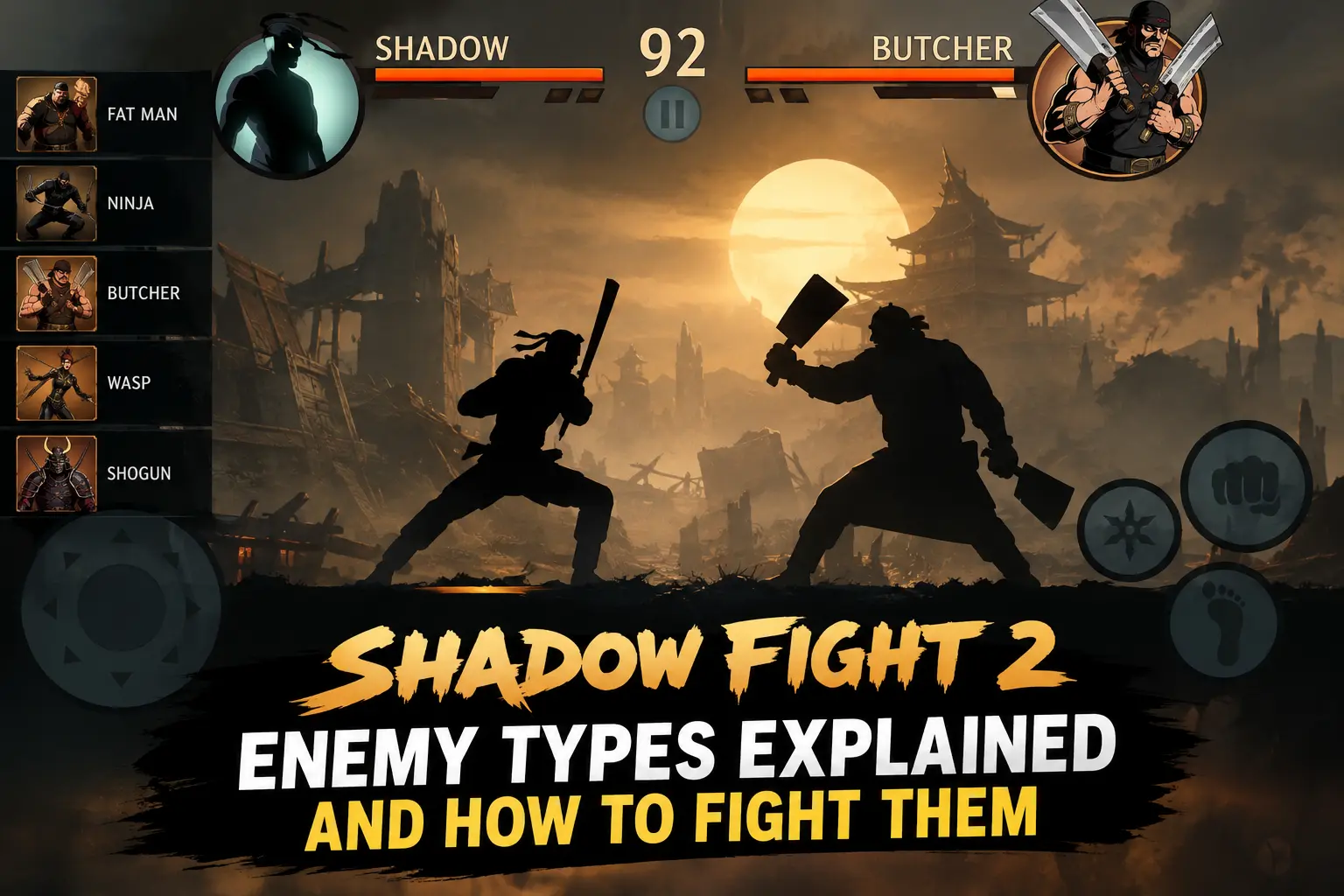
The six main demon bosses are Lynx, Hermit, Butcher, Wasp, Widow, and Shogun. Titan is the final major story opponent. Each boss presents a different challenge, so a strategy that works against one may not work against another.
The best starting point is to identify the boss’s most dangerous attacks and special abilities, then prepare your equipment accordingly.
Lynx
Lynx uses a fast, agile fighting style and can become difficult to track when his special abilities come into play.
How to approach the fight:
- Avoid rushing into every opening.
- Watch for his special attacks and respond to their timing.
- Use controlled attacks rather than long, risky combinations.
- Upgrade your equipment if his attacks are consistently overwhelming you.
Hermit
Hermit is associated with magic, making it important to pay attention to more than his physical attacks.
How to approach the fight:
- Watch for the start of his special attacks.
- Avoid predictable movement that makes you easy to target.
- Choose attack opportunities carefully instead of focusing only on offense.
- Improve your armor if incoming damage is preventing you from surviving long enough to learn his patterns.
Butcher
Butcher is a powerful opponent whose close-range pressure can punish careless attacks.
How to approach the fight:
- Be careful about entering his attack range.
- Watch for heavy strikes before committing to a move.
- Avoid unnecessary exchanges when your health is low.
- Counter when he finishes an attack and leaves an opening.
Wasp
Wasp can be challenging because of her mobility and distinctive weapon-based attacks.
How to approach the fight:
- Watch her movement before deciding when to approach.
- Avoid chasing her without a clear opening.
- Use your weapon’s reach and timing to manage the distance.
- Stay ready to defend when she changes position.
Widow
Widow combines dangerous attacks with special abilities that can make the fight difficult if you attack without observing her behavior.
How to approach the fight:
- Learn the timing of her attacks and special moves.
- Avoid committing to slow attacks when she is ready to respond.
- Use controlled counters when an opening appears.
- Make sure your armor and weapon are appropriate for your current progression.
Shogun
Shogun presents a demanding challenge because of his powerful attacks and the additional threats involved in his encounter.
How to approach the fight:
- Pay attention to the timing of his attacks and any additional attackers.
- Avoid focusing on offense when doing so exposes you to several threats.
- Use safe opportunities to deal damage instead of forcing a long combination.
- Improve your equipment if you are consistently losing health too quickly.
Titan
Titan is the final major story opponent and requires careful attention to his attack patterns and special abilities.
How to approach the fight:
- Enter with upgraded equipment suitable for your progression.
- Learn the timing of his strongest attacks.
- Avoid relying on repeated attacks that leave you vulnerable.
- Prioritize survival and take opportunities to counter when it is safe.
Important: Boss strategies are not guaranteed to work identically in every situation. Your equipment, timing, and version of the game can affect how a fight plays out. Focus on recognizing attack patterns rather than expecting one fixed combination to defeat every boss.
How to Choose Weapons Against Different Enemies
Your weapon affects your reach, attack speed, and the amount of time you spend committed to a move. There is no single weapon that is automatically best against every opponent.
| Weapon style | Potential advantage | What to watch out for |
|---|---|---|
| Fast, short-range weapons | Quick attacks and close-range pressure | You must get close enough to use them |
| Medium-range weapons | A balance of reach and control | Timing still matters against quick opponents |
| Long-range weapons | Can help maintain distance | Poor timing can leave you vulnerable |
| Heavy weapons | Can deliver powerful attacks | Slower moves may be easier to punish |
Choose a weapon that suits both the opponent and your own playstyle. If you struggle to approach an enemy, try a weapon with more reach. If you keep missing slow attacks, experiment with faster moves.
You should also consider armor, helmets, ranged weapons, and magic. Better equipment can help, but it cannot completely replace learning the opponent’s behavior.
Players who want to explore a different version of the game can also read our Shadow Fight 2 Special Edition guide to understand how its gameplay experience differs from the standard edition.
How to Read Enemy Attacks and Find Openings
Recognizing an attack before it lands is one of the most useful skills you can develop in Shadow Fight 2.
Follow this simple process:
- Watch the enemy’s movement. Look for the start of an attack instead of reacting only after it reaches you.
- Check the distance. Decide whether the move can reach you from your current position.
- Avoid or defend when necessary. Choose a response that matches the incoming attack and your available space.
- Wait for a safe opening. An opponent that has finished a committed move may be easier to punish.
- Use a controlled counter. Start with an attack you can execute reliably.
- Return to a safe position. Do not assume that landing one hit means the enemy cannot respond.
Practice this process against different opponents. Over time, you will become better at recognizing which attacks are safe to challenge and which ones should be avoided.
Common Mistakes Players Make Against Enemies
Even a strong weapon can feel ineffective when you use it without a plan. These mistakes are worth correcting before spending more resources on upgrades.
- Spamming attacks: Repeated button presses can leave you open to counters.
- Ignoring weapon range: Attacking from too far away wastes opportunities.
- Using the same strategy against everyone: Different opponents require different timing and positioning.
- Ignoring equipment upgrades: Underpowered gear can make later fights unnecessarily difficult.
- Chasing every enemy movement: Rushing after a moving opponent can lead you into attacks.
- Repeating a failed strategy: If the same move keeps getting punished, change your approach.
- Ignoring special abilities: Bosses and certain opponents may require you to react to more than ordinary weapon attacks.
The most useful habit is to identify why you lost each fight. Make one practical adjustment, try again, and observe whether it improves the result.
Frequently Asked Questions
What are the different enemy types in Shadow Fight 2?
You can group opponents by their behavior, such as fast attackers, defensive fighters, long-range weapon users, heavy attackers, and unpredictable opponents. These are practical strategy categories rather than a claim that the game officially labels enemies this way.
How do you defeat difficult enemies in Shadow Fight 2?
Study their attack patterns, manage your distance, avoid risky combinations, and counter when they leave an opening. Upgrade your weapon and armor if your equipment is too weak for the fight.
How do you beat fast enemies?
Use short, controlled attacks and watch for openings after their moves. Avoid repeatedly using slow attacks or attacking without considering their next move.
Which weapons are best against defensive enemies?
The best choice depends on the opponent and your playstyle. Experiment with different attack speeds, ranges, and combinations instead of relying on one weapon for every fight.
How can you avoid enemy attacks?
Watch attack animations, maintain useful spacing, and use appropriate movement or defensive actions. Learning when to move away and when to counter is more reliable than attacking continuously.
How do you prepare for a boss fight?
Review your current equipment, upgrade where needed, and learn the boss’s special attacks. If you lose, identify the main problem and adjust your approach before trying again.
Can you play Shadow Fight 2 on iOS?
Yes, players looking for the iPhone or iPad version can visit our Shadow Fight 2 for iOS page for platform-specific information.
Final Tips for Beating Enemies in Shadow Fight 2
Winning consistently is less about attacking constantly and more about understanding when to attack. Learn your opponent’s range, recognize their dangerous moves, and use safe openings to deal damage.
Choose weapons and equipment that fit the fight, but do not expect upgrades alone to solve every problem. If an enemy keeps defeating you, observe what happens before each hit and change one part of your strategy at a time.
With practice, patience, and better timing, you can handle different fighting styles more confidently and make progress through Shadow Fight 2’s increasingly challenging battles.